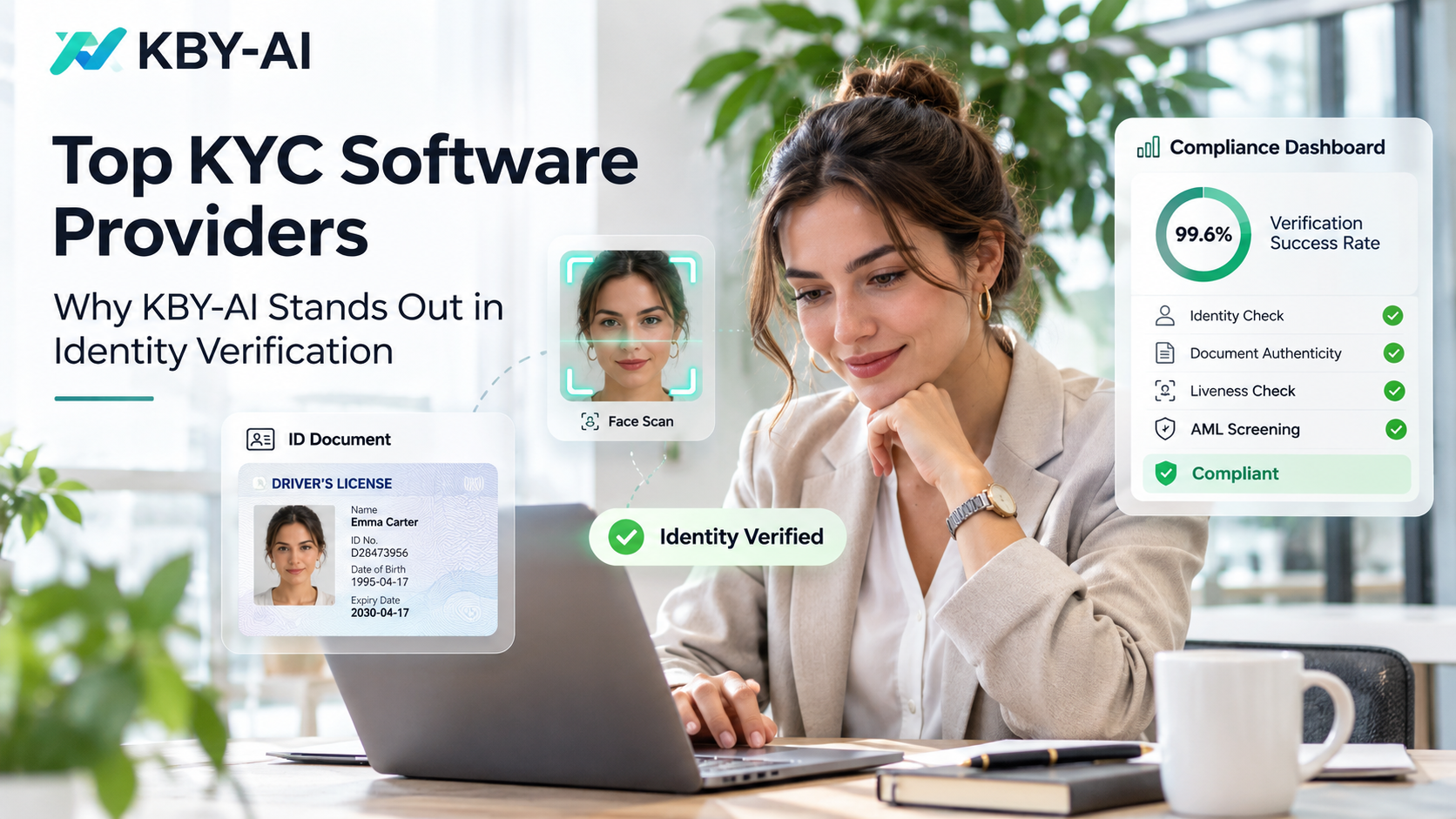
Compare the 5 best KYC software providers for 2027. Explore AI-powered identity verification, face liveness detection, fraud prevention, and on-premises SDKs.
As businesses continue to embrace digital transformation, establishing trust in online environments has become one of the most important challenges across financial services, banking, fintech, cryptocurrency, insurance, telecommunications, and e-commerce.
Traditional identity verification methods are increasingly challenged by sophisticated digital fraud, identity theft, synthetic identities, document manipulation, deepfake technology, and biometric spoofing attacks.
Organizations need intelligent, scalable, and secure Know Your Customer (KYC) solutions that can verify customer identities, reduce fraud risks, simplify compliance operations, and deliver a seamless digital onboarding experience.
However, selecting the best KYC software provider is not simply about finding a platform that scans identity documents or compares facial images. Businesses must also consider verification accuracy, biometric security, infrastructure requirements, integration flexibility, data privacy, licensing costs, and long-term scalability.
While some KYC solution providers focus on comprehensive cloud-based compliance platforms, others specialize in advanced identity verification technologies that businesses can integrate directly into their existing applications and infrastructure.
At KBY-AI, we focus on providing AI-powered identity verification SDKs that enable organizations to build secure, customizable, and scalable KYC systems while maintaining greater control over their technology infrastructure and sensitive customer information.
In this comprehensive guide, we explore five KYC software providers to consider in 2027, examine their respective strengths, and explain the essential technologies businesses should evaluate when selecting an identity verification solution.
What Is KYC Software?
KYC software is a digital technology solution designed to help organizations establish and verify the identities of their customers.
Know Your Customer procedures play an important role in reducing identity fraud, preventing financial crime, supporting customer due diligence, and helping regulated businesses meet applicable compliance requirements.
Unlike traditional identity verification processes that rely heavily on manual document inspection, modern KYC software uses artificial intelligence, computer vision, optical character recognition (OCR), facial recognition, and biometric liveness detection to automate various stages of the verification process.
A typical automated KYC verification workflow may include:
-
Government-issued identity document capture.
-
Identity document recognition and information extraction.
-
Document authenticity and liveness checks.
-
Customer selfie capture.
-
Facial biometric analysis.
-
Face matching between the selfie and document portrait.
-
Presentation attack detection.
-
Customer risk assessment.
-
Additional compliance screening when required.
By integrating these technologies, organizations can establish more reliable digital onboarding processes while reducing their dependence on repetitive manual verification.
However, identity verification is only one component of a complete KYC compliance program. Depending on the industry and jurisdiction, organizations may also require anti-money laundering screening, sanctions checks, transaction monitoring, enhanced due diligence, and ongoing customer risk management.
The best KYC software is therefore the solution that aligns with an organization’s specific security, operational, technical, and regulatory requirements.
Top 5 KYC Software Providers in 2027
The following providers represent different approaches to digital identity verification and KYC automation.
| KYC Software Provider | Primary Specialization | Ideal Use Cases |
|---|---|---|
| KBY-AI | AI-powered biometric verification, document recognition, on-premises SDKs | Enterprises, fintech companies, banks, and developers building customized identity verification systems |
| Persona | Configurable identity verification and workflow automation | Organizations requiring flexible customer onboarding and fraud investigation workflows |
| Trulioo | Global individual and business identity verification | International companies requiring access to diverse identity verification methods |
| Sumsub | KYC, KYB, AML, and transaction monitoring | Businesses requiring comprehensive compliance management |
| Jumio | Digital identity verification and risk screening | Organizations seeking integrated identity verification and compliance screening |
These providers are not ranked through an independent performance benchmark. Each offers a different combination of verification technologies, compliance capabilities, deployment models, and commercial arrangements.
The appropriate solution depends on whether your business requires a complete managed compliance platform or advanced identity verification components that can operate within your existing infrastructure.
1. KBY-AI – AI-Powered Identity Verification and On-Premises KYC Solutions
KBY-AI is an AI technology provider specializing in facial recognition, biometric liveness detection, identity document recognition, document liveness detection, and digital identity verification.
Unlike conventional identity verification platforms that primarily operate as externally managed services, KBY-AI provides software development kits that enable organizations to integrate identity verification functionality directly into their own applications.
This SDK-based approach is particularly valuable for businesses that require greater infrastructure control, customized verification workflows, flexible deployment options, and predictable software licensing costs.
KBY-AI’s identity verification technologies can support digital customer onboarding, biometric authentication, fraud prevention, identity verification, and electronic Know Your Customer (eKYC) processes.
Advanced Face Recognition SDK
Facial recognition is a fundamental component of modern biometric identity verification.
When a customer submits an identity document and a selfie, facial recognition technology can help determine whether the two facial images belong to the same individual.
The KBY-AI Face Recognition SDK uses facial biometric technology to extract facial features and perform identity matching.
Businesses can integrate this functionality into applications that require:
-
Selfie-to-ID portrait matching.
-
One-to-one facial verification.
-
Biometric customer authentication.
-
Identity confirmation during digital onboarding.
-
Facial verification during account recovery.
-
Identity verification for sensitive operations.
By incorporating facial recognition into KYC workflows, organizations can strengthen the connection between a customer’s presented identity document and the person attempting to access a service.
Facial recognition can also be used beyond initial registration, allowing businesses to introduce additional identity confirmation when their internal risk management policies require it.
The suitability of facial matching thresholds should be evaluated using representative customer populations, device conditions, and operational requirements.
Learn more: KBY-AI Face Recognition SDK
AI-Powered Face Liveness Detection SDK
One of the most significant challenges in remote identity verification is determining whether a biometric sample originates from a real person rather than an artificial representation.
Facial matching alone is insufficient because a fraudulent presentation may contain the facial appearance of a legitimate individual.
Face liveness detection introduces an additional security layer by analyzing biometric input for indications of presentation attacks.
The KBY-AI Face Liveness Detection SDK is designed to identify various forms of facial spoofing, including printed photographs, screen-based presentations, replayed videos, and certain mask-based attacks.
KBY-AI also offers passive face liveness detection technology, which can reduce the need for users to perform predefined physical actions during verification.
This approach can help businesses improve the balance between onboarding convenience and biometric security.
Passive liveness detection is particularly useful for mobile banking applications, financial technology platforms, remote customer onboarding, access control, and other applications where user experience is important.
For organizations evaluating liveness detection software, it is essential to consider performance across different cameras, lighting environments, device types, and presentation attack categories.
Independent evaluation results should be reviewed alongside real-world testing within the intended deployment environment.
Learn more: KBY-AI Face Liveness Detection SDK
Intelligent ID Document Recognition SDK
Identity documents remain an essential source of evidence in digital onboarding and identity verification.
Manually entering personal information from passports, identity cards, or driver’s licenses can introduce errors, increase processing time, and create unnecessary administrative work.
The KBY-AI ID Document Recognition SDK uses computer vision and optical character recognition technologies to automate document detection and information extraction.
Depending on the supported document type, the technology can help extract information such as:
-
Full name.
-
Date of birth.
-
Document number.
-
Nationality.
-
Document expiration date.
-
Machine-readable information.
-
Facial portrait images.
-
Other supported document fields.
The extracted information can be transferred into customer registration forms, internal databases, verification workflows, and existing enterprise systems.
Automated document recognition can help organizations reduce repetitive data entry, improve information consistency, and create more efficient customer onboarding experiences.
For international businesses, document recognition coverage should be assessed according to the countries, languages, and identity document formats their customers actually use.
Learn more: KBY-AI ID Document Recognition SDK
ID Document Liveness Detection
Extracting information from an identity document does not automatically establish that the submitted document is genuine or that the customer is presenting a physical document.
Fraudulent identity verification attempts may involve reproduced documents, digitally manipulated images, or previously captured document photographs.
KBY-AI’s ID Document Liveness Detection SDK is designed to help identify suspicious document presentations, including printed reproductions, screen-based replay presentations, and certain portrait substitution attacks.
Document liveness detection adds another security signal to the identity verification process.
When combined with document recognition, facial recognition, and face liveness detection, it enables businesses to construct a multilayered verification workflow.
This is particularly relevant for organizations that rely on remote customer onboarding without direct physical interaction between customers and verification personnel.
Document liveness should be combined with additional authenticity checks when higher levels of document assurance are required.
Learn more: KBY-AI ID Document Liveness Detection SDK
On-Premises Identity Verification
One of KBY-AI’s key differentiators is its support for on-premises identity verification.
Many organizations operate under strict internal data governance policies that influence where sensitive information can be processed and stored.
An on-premises deployment allows businesses to operate supported verification technologies within infrastructure they control.
This deployment model can be especially relevant for financial institutions, government organizations, healthcare providers, enterprise security systems, and companies with specific data residency requirements.
Organizations can design their infrastructure to determine how biometric information is collected, processed, retained, and protected.
Potential advantages of on-premises KYC deployment include:
-
Greater control over sensitive customer data.
-
Customizable infrastructure and network architecture.
-
Integration with existing enterprise systems.
-
Reduced dependence on externally hosted verification services.
-
Support for internal data governance requirements.
-
Greater flexibility over verification workflows.
-
Control over infrastructure scaling and resource allocation.
On-premises deployment does not automatically guarantee regulatory compliance or data security. Organizations remain responsible for implementing appropriate access controls, encryption, retention policies, monitoring, infrastructure security, and operational safeguards.
Nevertheless, for businesses that prioritize technological independence and infrastructure control, an on-premises identity verification solution can provide significant architectural advantages.
Offline and On-Device Processing
Certain identity verification applications operate in environments where internet connectivity is limited, unreliable, or restricted.
KBY-AI offers supported SDK configurations capable of performing selected verification functions offline or directly on compatible devices.
On-device processing can reduce the need to transmit biometric images to external servers for every verification operation.
Potential applications include remote field operations, enterprise access control, secure mobile applications, offline registration systems, and other environments where continuous connectivity cannot be guaranteed.
Businesses should evaluate which verification functions can operate locally and which additional processes, such as database screening or external compliance checks, require network access.
This distinction is particularly important when designing a complete electronic KYC system.
Perpetual Licensing and Long-Term Cost Efficiency
Software licensing is another important consideration when evaluating the best KYC software providers.
Some identity verification services use transaction-based pricing, where organizations pay according to the number of verification requests or completed customer checks.
Although this approach can be appropriate for organizations with limited infrastructure resources or unpredictable verification volumes, costs may increase as customer activity grows.
KBY-AI offers perpetual licensing options for its SDK products.
According to its published licensing information, mobile SDK licenses are associated with an application ID, while server SDK licenses are associated with a machine identifier.
This licensing model allows organizations to purchase eligible software licenses through a one-time payment rather than paying recurring SDK licensing fees.
For businesses processing substantial verification volumes, perpetual licensing may provide a more predictable software cost structure.
However, total ownership costs should also account for infrastructure, development resources, maintenance, additional licenses, scaling, and third-party compliance services.
Learn more: KBY-AI SDK Pricing and Licensing
Flexible SDK and API Integration
KBY-AI provides identity verification technologies for multiple development environments, including supported mobile and server-side implementations.
This gives development teams the opportunity to incorporate biometric and document verification functionality into their existing products rather than replacing their entire application architecture.
Organizations can combine KBY-AI SDKs with proprietary onboarding interfaces, internal customer management systems, enterprise security applications, compliance engines, and third-party risk assessment services.
For example, a fintech company can integrate facial liveness detection and document recognition into its mobile application while continuing to use its existing AML screening provider.
This modular architecture can be particularly valuable for organizations that have already invested in customer onboarding infrastructure and want to improve specific verification capabilities.
KBY-AI is therefore especially relevant for businesses that want to build and manage their own identity verification experience.
Best suited for: Enterprises, banks, fintech companies, software developers, system integrators, and organizations seeking customizable biometric identity verification, on-premises deployment, and perpetual SDK licensing.
Explore our complete KYC Verification Solution.
2. Persona – Configurable Identity Verification and Workflow Automation
Persona provides identity verification infrastructure designed to support customer onboarding, identity management, and risk-related workflows.
Its platform offers tools that allow businesses to configure verification experiences according to different customer profiles and operational requirements.
Organizations can combine government-issued identity document checks, selfie verification, database verification, and additional risk assessment mechanisms within configurable workflows.
Persona also provides business verification capabilities that can help organizations evaluate corporate customers and relevant individuals associated with those businesses.
A notable aspect of Persona is its emphasis on identity workflow orchestration. Businesses can establish different verification requirements based on customer characteristics, verification outcomes, or internal risk policies.
This approach can be useful for organizations that require multiple verification journeys rather than applying the same onboarding process to every customer.
For example, a digital marketplace may establish different verification requirements for buyers, sellers, and businesses operating on its platform.
When evaluating Persona, organizations should consider their workflow complexity, integration requirements, verification volumes, and preferred infrastructure model.
Best suited for: Businesses requiring configurable identity verification journeys, workflow automation, and identity investigation capabilities.
3. Trulioo – Global Identity and Business Verification
Trulioo provides identity verification and business verification technologies for organizations operating across international markets.
Global customer onboarding introduces several challenges because identity documents, government records, available data sources, and verification practices vary across jurisdictions.
Trulioo addresses these requirements through a platform that supports individual identity verification, business verification, document-based checks, and configurable verification workflows.
Its business verification capabilities can assist organizations with establishing the identities of corporate customers and examining business-related information.
The availability of multiple verification methods can be particularly valuable for businesses expanding internationally.
For example, a cross-border payment company may need to adapt its identity verification process according to the country in which a customer resides and the information available within that market.
Businesses evaluating Trulioo should investigate the specific data sources, verification methods, and document coverage available in their priority jurisdictions.
They should also assess how the platform integrates with existing compliance systems and customer onboarding applications.
Best suited for: International financial institutions, cross-border payment companies, global enterprises, and businesses requiring individual and corporate identity verification across multiple markets.
4. Sumsub – Comprehensive KYC, KYB, and AML Compliance
Sumsub offers a broad compliance technology platform covering customer identity verification, business verification, financial crime risk management, and transaction monitoring.
Its product portfolio makes it relevant to organizations seeking to consolidate several compliance-related operations within a single provider ecosystem.
Beyond individual identity verification, Sumsub provides tools for Know Your Business (KYB), anti-money laundering screening, transaction monitoring, and cryptocurrency-related compliance workflows.
For organizations operating in highly regulated industries, combining these capabilities may reduce the complexity of managing numerous independent compliance systems.
A cryptocurrency exchange, for instance, may require identity verification during account registration, customer risk screening, ongoing monitoring, and additional verification when suspicious activity is identified.
A broad compliance platform can help coordinate these activities.
However, organizations should carefully evaluate which capabilities are included in their commercial agreement, which require separate services, and how the resulting platform integrates with internal infrastructure.
Best suited for: Fintech platforms, cryptocurrency businesses, payment service providers, and organizations seeking a comprehensive compliance technology ecosystem.
5. Jumio – Digital Identity Verification and Risk Screening
Jumio provides digital identity verification, authentication, and risk screening solutions for businesses operating in online environments.
Its technologies combine identity document verification and biometrics with additional risk assessment and compliance-related services.
Jumio also offers AML screening capabilities that can help organizations evaluate customers against relevant sanctions lists, politically exposed person information, and other risk data sources.
By integrating identity verification with customer screening, businesses can connect identity confirmation with broader due diligence activities.
This approach is relevant to organizations that want to streamline digital registration and compliance screening within a connected verification environment.
When evaluating Jumio, businesses should assess the availability of required document types, biometric verification capabilities, screening coverage, integration methods, and commercial terms.
It is also important to determine how identity verification results and screening decisions fit into existing internal review and escalation processes.
Best suited for: Financial institutions, digital businesses, and enterprises seeking integrated identity verification and customer risk screening.
How to Choose the Best KYC Software for Your Business
Selecting the right KYC solution requires more than comparing product descriptions or the number of features advertised by different vendors.
Organizations should evaluate how the technology will perform within their actual business environment.
1. Identity Verification Accuracy
Verification accuracy directly influences both security and customer experience.
A system that incorrectly accepts fraudulent identity submissions can expose a business to financial and operational risks. Conversely, a system that frequently rejects legitimate customers can increase onboarding abandonment and manual review costs.
Organizations should evaluate false acceptance rates, false rejection rates, document extraction accuracy, biometric matching performance, and operational failure rates.
Independent biometric evaluations can provide useful evidence, but businesses should also conduct their own testing using representative documents, customer populations, cameras, and environmental conditions.
Performance should be assessed at the operating thresholds that the organization intends to use in production.
2. Biometric Liveness and Presentation Attack Detection
Modern identity verification systems must evaluate more than whether two facial images appear similar.
They must also address the authenticity of the biometric presentation.
Liveness detection helps organizations identify suspicious biometric input and reduce the risk of identity impersonation.
When comparing providers, businesses should evaluate the supported presentation attack categories, verification experience, device compatibility, independent assessment results, and failure-handling mechanisms.
Organizations should also distinguish between presentation attack detection and digital injection attack protection, because they address different threats.
A comprehensive security strategy may require additional application integrity controls and secure capture mechanisms.
3. Document Recognition and Authentication
The quality of identity document processing can significantly influence the reliability of customer onboarding.
Businesses should determine whether the software supports their required document types, languages, and document fields.
It is also important to understand the distinction between document recognition and document authentication.
Recognition focuses on identifying the document and extracting information. Authentication evaluates evidence associated with document legitimacy.
Depending on the level of assurance required, organizations may need additional security feature inspection, electronic chip validation, authoritative database checks, or manual document examination.
A solution should be evaluated according to the depth of verification required rather than document coverage alone.
4. Data Privacy and Infrastructure Control
Identity verification frequently involves sensitive personal information, including government-issued identification documents and biometric data.
Organizations must understand how this information moves through their verification architecture.
Important considerations include data processing locations, retention policies, encryption, access permissions, audit logging, and deletion capabilities.
Cloud-based platforms may simplify deployment and infrastructure management. On-premises and on-device solutions can give organizations greater direct control over processing environments.
Neither approach is automatically more secure in every situation.
The appropriate deployment model depends on internal technical expertise, applicable privacy obligations, security policies, and operational priorities.
5. Integration Flexibility
The best KYC solution should integrate effectively with the systems a business already operates.
These may include mobile applications, websites, customer relationship management platforms, core banking systems, compliance applications, and internal databases.
Organizations should evaluate SDK availability, API documentation, supported operating systems, software dependencies, error handling, deployment requirements, and technical support.
A modular SDK-based approach can be advantageous when a business needs to add identity verification functionality without redesigning its entire onboarding infrastructure.
A managed platform may be preferable when an organization wants to outsource more of the verification process.
6. Scalability and Total Cost of Ownership
Businesses should evaluate the total cost of operating identity verification software over several years rather than focusing exclusively on initial pricing.
The total cost of ownership may include:
-
Software licensing.
-
Verification transaction fees.
-
Server infrastructure.
-
Development and integration.
-
Manual verification and review.
-
Security maintenance.
-
Additional compliance services.
-
Technical support.
-
Infrastructure expansion.
Organizations should estimate verification volumes under realistic growth scenarios.
For high-volume applications, the difference between usage-based fees and perpetual software licensing can become commercially significant.
However, organizations should account for additional infrastructure and license requirements before determining which model is more cost-effective.
Cloud-Based vs. On-Premises KYC Software
One of the most important architectural decisions is whether to use a vendor-managed identity verification platform or deploy verification software within customer-controlled infrastructure.
| Comparison Factor | Cloud-Based KYC | On-Premises KYC |
|---|---|---|
| Infrastructure | Typically managed by the provider | Managed by the customer |
| Deployment | Often faster to initiate | Requires infrastructure preparation |
| Data processing | Within contracted service environments | Within customer-controlled environments |
| Customization | Depends on platform capabilities | Greater architectural flexibility |
| Pricing | Often subscription or usage-based | May include perpetual licensing |
| Maintenance | Generally shared with or handled by the provider | Primarily managed by the customer |
| Offline processing | Usually requires connectivity | Possible with supported local SDKs |
| Scalability | Managed service capacity | Customer-designed capacity |
Cloud-based KYC platforms can be attractive for organizations that want to reduce infrastructure responsibilities.
On-premises KYC solutions are particularly relevant for businesses that prioritize infrastructure independence, customized processing environments, and greater control over biometric data.
KBY-AI’s SDK-based approach enables organizations to evaluate customer-managed deployment options and incorporate identity verification directly into their existing applications.
How KBY-AI Supports an Automated KYC Verification Workflow
A comprehensive digital identity verification process can combine several complementary technologies.
The following example illustrates how businesses can design a KYC verification workflow using KBY-AI SDKs.
Step 1: Identity Document Capture
The customer captures an image of a supported identity document using a compatible mobile device or application.
The application checks image quality and determines whether the document can be processed.
Step 2: Document Liveness Verification
Document liveness technology analyzes the submitted document presentation for supported indications of manipulation or reproduction.
Suspicious results can be routed to an additional verification process according to the organization’s security policies.
Step 3: Identity Information Extraction
The ID Document Recognition SDK extracts supported identity information and facial portrait data from the document.
The application can use this information to populate registration forms and establish the customer’s claimed identity.
Step 4: Selfie Capture and Face Liveness Detection
The customer provides a facial image through the application.
Face liveness detection evaluates the biometric presentation for indications of spoofing or artificial presentation.
Step 5: Biometric Face Matching
The facial recognition technology compares the customer’s selfie with the portrait extracted from the identity document.
The result provides a biometric similarity signal that can be considered alongside other verification evidence.
Step 6: Verification Decision
The business combines document recognition results, document liveness results, facial liveness results, facial matching scores, and any additional compliance checks.
The organization’s internal decision engine determines whether to approve the verification, request additional information, or escalate the case for manual review.
This architecture allows businesses to retain control over their verification rules while leveraging specialized AI-powered identity verification technology.
Industries That Benefit From AI-Powered KYC Software
Banking and Financial Services
Banks can use digital identity verification technologies to support remote account opening, customer identity confirmation, and additional verification during sensitive account operations.
Combining document recognition with biometric verification can help financial institutions create more efficient digital onboarding experiences while supporting their broader risk management procedures.
Fintech and Digital Payments
Fintech companies frequently need to onboard customers rapidly while managing identity fraud and financial crime risks.
SDK-based identity verification allows fintech developers to incorporate biometric and document processing directly into branded mobile applications and payment platforms.
Cryptocurrency and Web3
Cryptocurrency exchanges and regulated digital asset businesses may require identity verification to support applicable customer due diligence requirements.
Biometric verification can contribute to customer identity assurance, while separate screening and transaction monitoring tools address other financial crime risks.
Insurance
Insurance providers can use document recognition and facial verification to support customer registration, identity confirmation, and selected claims-related processes.
Automating repetitive identity checks may improve operational efficiency while allowing personnel to focus on complex or higher-risk cases.
Telecommunications
Telecommunications companies can integrate identity verification into customer registration, digital SIM activation, and subscriber identity confirmation where required.
On-device verification technologies can also support selected field registration scenarios.
Government and Enterprise Applications
Government agencies and large enterprises may have specific requirements concerning infrastructure ownership, sensitive information processing, and internal security controls.
On-premises biometric SDKs can help these organizations build identity verification functionality within controlled environments.
How to Evaluate KYC Software Before Purchasing
A successful implementation should begin with a structured proof of concept.
Rather than relying solely on vendor demonstrations, businesses should create an evaluation framework that reflects their real operational environment.
Consider testing the following scenarios:
-
Supported identity documents from priority markets.
-
Different mobile devices and camera configurations.
-
Variable lighting and image quality.
-
Legitimate users completing standard verification.
-
Authorized biometric and document security test scenarios.
-
Incomplete or low-quality submissions.
-
High-volume verification requests.
-
Manual review and escalation workflows.
-
Infrastructure and network interruptions.
Organizations should measure the time required to complete verification, the percentage of legitimate customers who successfully finish the process, the frequency of manual intervention, and the technical resources required to operate the software.
It is also useful to compare the total cost per successfully verified customer rather than the advertised cost of an individual verification request.
These measurements provide a stronger basis for selecting a long-term identity verification technology partner.
Why Consider KBY-AI for Your Identity Verification Requirements?
KBY-AI is designed for organizations that want more than a predefined identity verification experience.
Our approach enables businesses to incorporate specialized AI-powered technologies into their own applications, infrastructure, and customer onboarding systems.
By combining facial recognition, face liveness detection, identity document recognition, and document liveness detection, businesses can establish multilayered digital identity verification workflows.
KBY-AI offers several important advantages for organizations evaluating SDK-based identity verification:
-
AI-powered biometric verification technologies.
-
Passive face liveness detection.
-
Automated identity document information extraction.
-
Document presentation attack detection.
-
On-premises deployment options.
-
Supported offline and on-device processing.
-
Flexible mobile and server-side integration.
-
Perpetual SDK licensing options.
-
Technical integration support.
-
Compatibility with customized identity verification architectures.
Whether your organization is developing a digital banking application, a fintech onboarding platform, an enterprise authentication system, or a specialized identity verification product, KBY-AI provides technologies that can serve as building blocks for your solution.
Businesses can combine our SDKs with their existing compliance services and risk management systems to create verification architectures aligned with their particular requirements.
Build your own identity verification solution with KBY-AI.
Explore our official website, review our developer documentation, or evaluate our technology through the online demonstration platform.
Frequently Asked Questions About KYC Software
What is the best KYC software provider in 2027?
The best KYC software provider depends on your business requirements.
KBY-AI is particularly relevant for businesses seeking AI-powered biometric SDKs, on-premises identity verification, customizable integration, and perpetual licensing.
Providers such as Persona, Trulioo, Sumsub, and Jumio offer different combinations of identity verification, workflow management, global data services, and compliance screening.
Organizations should evaluate providers against their own technical, operational, and regulatory requirements.
What is the difference between KYC and identity verification?
Identity verification establishes whether an individual is who they claim to be.
KYC is a broader customer due diligence process that may also involve customer risk assessment, compliance screening, ongoing monitoring, and additional checks.
Identity verification is an important component of KYC, but it does not independently satisfy every compliance obligation.
Can KYC software be deployed on-premises?
Yes. Some identity verification technology providers, including KBY-AI, offer software that can be deployed within customer-controlled infrastructure.
This approach can help organizations customize verification architecture and retain greater control over sensitive information processing.
Can identity verification work without an internet connection?
Certain identity verification functions can operate offline using compatible on-device SDKs.
KBY-AI offers supported offline processing capabilities for selected technologies. External database checks, sanctions screening, and other network-dependent compliance activities may still require connectivity.
What is face liveness detection in KYC?
Face liveness detection is a biometric security technology designed to evaluate whether a facial presentation originates from a live person rather than certain forms of artificial or reproduced biometric input.
It complements facial recognition and helps reduce the risk of impersonation during digital identity verification.
Does KBY-AI offer perpetual SDK licensing?
Yes. KBY-AI offers perpetual licensing options for its supported SDK products.
Businesses can evaluate application-based mobile licenses and machine-based server licenses according to their deployment requirements.
Additional infrastructure and license costs should be considered when planning larger deployments.
Can KBY-AI be integrated into an existing KYC platform?
Yes. KBY-AI’s SDK-based technologies can be integrated into existing applications and verification architectures.
Businesses can combine KBY-AI’s biometric and document verification technologies with their own customer onboarding systems, compliance providers, and internal decision-making processes.
What is the difference between KYC and AML software?
KYC focuses on understanding and establishing customer identities and associated risks.
Anti-money laundering software supports broader financial crime prevention activities, which may include sanctions screening, transaction monitoring, investigation workflows, and regulatory reporting.
Organizations may require both identity verification technology and dedicated AML capabilities.
How can businesses reduce the cost of identity verification?
Businesses can reduce unnecessary verification costs by improving automated workflows, minimizing avoidable manual reviews, selecting appropriate infrastructure, and choosing licensing models aligned with their verification volumes.
Perpetual SDK licensing may provide long-term cost advantages for organizations with stable or high-volume identity verification requirements.
Is KBY-AI suitable for banks and fintech companies?
KBY-AI provides biometric and document verification technologies that banks and fintech companies can evaluate for digital onboarding, customer identity verification, biometric authentication, and fraud prevention.
The final implementation should be assessed against the institution’s security, performance, privacy, and regulatory requirements.
Conclusion: Build the Next Generation of Digital Identity Verification With KBY-AI
As businesses prepare for 2027, digital identity verification will remain an essential component of secure online services.
Organizations must address evolving fraud risks while providing convenient customer experiences and maintaining appropriate control over sensitive personal information.
The best KYC software providers offer different approaches to these challenges.
Some provide comprehensive managed compliance platforms, while others specialize in advanced biometric and document verification technologies that businesses can integrate directly into their products.
KBY-AI focuses on empowering organizations with flexible AI-powered identity verification SDKs, customizable integration, on-premises deployment, supported offline processing, and perpetual licensing options.
Our technologies enable developers and enterprises to build identity verification solutions that reflect their own operational priorities rather than relying exclusively on predefined verification workflows.
By combining facial recognition, face liveness detection, document recognition, and document liveness detection, KBY-AI helps organizations establish a stronger technological foundation for digital identity verification and automated customer onboarding.
Smarter identity verification. Stronger digital trust. Greater control over your technology.
Discover how KBY-AI can support your next identity verification project.
Official website: https://kby-ai.com/
KYC Verification Solution: https://kby-ai.com/kyc-verification-solution/
Developer Documentation: https://docs.kby-ai.com/help
Try Online: https://web.kby-ai.com/