
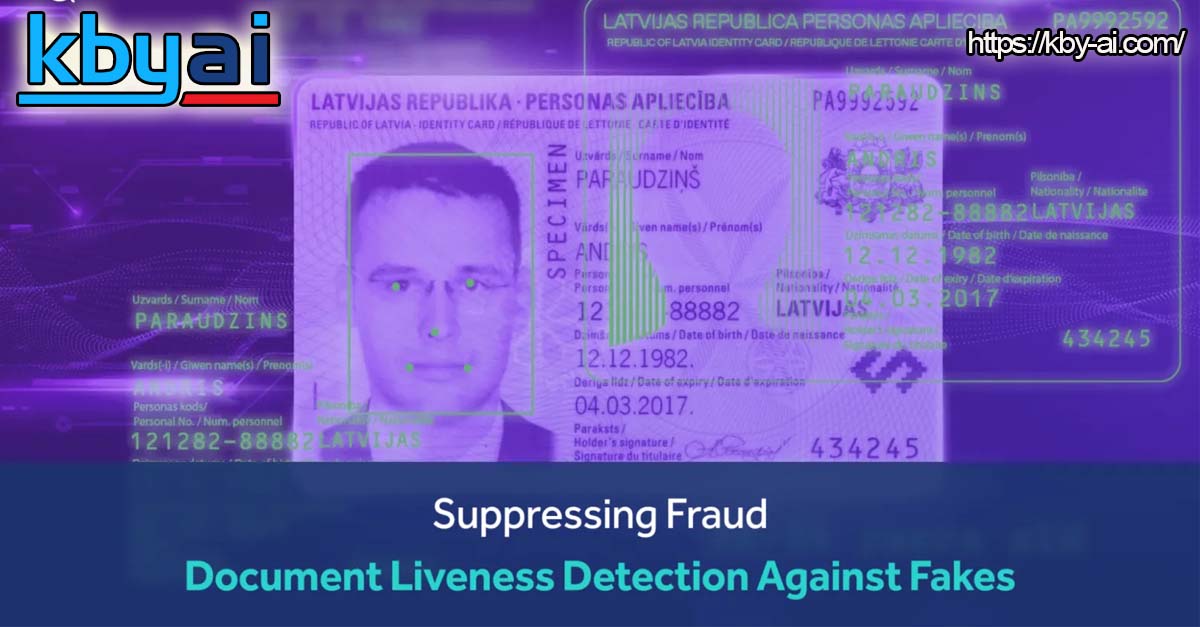
In today’s hyper-connected, digital-first economy, identity has become a form of currency. From opening a bank account and onboarding to fintech apps to registering SIM cards, verifying age, or accessing government and healthcare services, digital identity verification is now a fundamental requirement across industries.
However, as digital services expand, identity fraud has evolved at an alarming pace. Cybercriminals no longer rely on simple photocopies or stolen IDs. Instead, they use high-resolution printed forgeries, screen replay attacks, AI-generated synthetic identities, animated deepfake documents, and even manipulated holographic elements.
Traditional document verification technologies—while still essential—were never designed to defend against these modern threats on their own. This is where Document Liveness Detection emerges as the next critical evolution in digital security.
At KBY-AI, we believe that document verification must be secure, accurate, privacy-preserving, frictionless, and globally scalable. Our Document Liveness Detection technology transforms static document capture into an intelligent, fraud-resistant identity verification pipeline that works seamlessly across devices, platforms, and industries.
This in-depth guide explores the complete landscape of Document Liveness Detection: what it is, how it works, why it is now essential, and how KBY-AI’s on-device and on-premise solutions are setting a new global benchmark for secure digital identity.
1. Understanding Document Liveness Detection: Beyond Traditional OCR
1.1 What Is Document Liveness Detection?
Document Liveness Detection is an advanced anti-spoofing technology that verifies whether an identity document—such as a passport, national ID card, driver’s license, or residence permit—is:
-
Genuine and unaltered
-
Physically present in front of the camera
-
Captured live at the time of verification
-
Not a replay, printout, or digital manipulation
Unlike traditional document recognition systems that focus mainly on OCR, MRZ scanning, or barcode decoding, document liveness detection evaluates the physical authenticity of the document itself.
It answers critical security questions such as:
-
Is this a real, tangible document rather than a digital image?
-
Is the document being captured live, not replayed from a screen?
-
Do holograms, shadows, and textures behave like a genuine ID?
-
Does the document surface react correctly to movement and lighting?
-
Is the user attempting to deceive the system with printed copies or AI-edited images?
In simple terms, document liveness detection ensures that the ID is alive—not a static or fabricated copy.
1.2 Why Document Liveness Detection Matters More Than Ever
Modern identity fraud has become highly sophisticated. Attackers increasingly rely on:
-
Ultra-high-resolution printed IDs
-
Screen replays on smartphones and tablets
-
Edited screenshots and manipulated PDFs
-
AI-enhanced document forgeries
-
3D-printed document replicas
-
Synthetic IDs generated by deep learning models
-
MRZ and barcode injection attacks
These techniques easily bypass many legacy OCR-based systems. Document liveness detection introduces a critical second layer of defense, ensuring that the document itself is authentic and physically present during verification.
Industries that benefit most include:
-
Banking and fintech
-
KYC and AML compliance platforms
-
Telecom and SIM card registration
-
Government and e-government services
-
eCommerce and online marketplaces
-
Travel, hospitality, and aviation
-
Education and remote exams
-
Healthcare and digital pharmacies
-
Gig economy and workforce platforms
-
Age verification and content access services
In today’s threat landscape, document liveness detection is no longer optional—it is foundational.

2. The Evolution of Document Fraud and the Urgent Need for Liveness
2.1 From Traditional Fraud to AI-Driven Attacks
Legacy fraud methods were relatively simple and included:
-
Stolen physical documents
-
Photocopies
-
Basic Photoshop edits
Modern fraud techniques, however, are far more dangerous:
-
AI-generated document forgeries
-
Mobile screen replay attacks
-
Ultra-high-DPI printed fake IDs
-
Animated deepfake documents
-
MRZ and barcode manipulation
-
Simulated multi-layer holograms
-
Fully synthetic identity documents
Organizations that rely solely on OCR or manual verification are increasingly exposed to massive financial losses, regulatory penalties, and reputational damage.
2.2 Rising Regulatory Pressure Worldwide
Governments and regulators now require stronger identity assurance mechanisms. Global frameworks increasingly emphasize liveness detection—not just for faces, but also for documents.
Key regulations and standards include:
-
KYC and AML regulations for banks and fintechs
-
NIST 800-63-3 Digital Identity Guidelines
-
EU eIDAS 2.0
-
FATF identity verification guidance
-
GDPR and global data protection laws
-
Telecom SIM registration mandates
-
PSD2 and strong customer authentication
Many of these frameworks explicitly demand proof of document liveness.
KBY-AI’s Document Liveness Detection is designed to align seamlessly with these global compliance requirements.
3. How Document Liveness Detection Works: Inside the Technology
KBY-AI’s Document Liveness Detection system combines computer vision, deep learning, optical modeling, and contextual signal analysis to distinguish real documents from spoofed reproductions.
Below is a practical overview of how it works.
3.1 Texture and Material Analysis
Authentic identity documents contain microscopic features that are extremely difficult to replicate.
Our system analyzes:
-
Microprint patterns
-
Embossed and raised elements
-
Paper and plastic fiber irregularities
-
Laser engraving depth
-
Glossy and matte surface transitions
Even the most convincing forgeries fail under close texture inspection.
3.2 Light Reflection and Hologram Verification
Government-issued IDs incorporate advanced optical security features such as:
-
Holograms
-
Color-shifting inks
-
Retroreflective layers
-
UV and IR responsive areas
KBY-AI evaluates:
-
Hologram movement under device motion
-
Reflection angles and light diffusion
-
Surface deformation behavior
Printed copies and screen-based attacks cannot replicate these optical responses.
3.3 Shadow Behavior and Depth Estimation
Real documents naturally produce depth, curvature, and dynamic shadows when moved.
Using 3D spatial modeling, our system detects:
-
Natural shadow falloff
-
Physical bending and warping
-
Depth consistency across frames
Flat images and digital displays fail these checks immediately.
3.4 Motion Dynamics Analysis
Human hand movement introduces subtle, unpredictable motion.
Document liveness detection analyzes:
-
Micro-vibrations
-
Non-linear reflection changes
-
Frame-to-frame texture variation
Static photos, video replays, and AI-generated animations cannot replicate these dynamics convincingly.
3.5 Advanced Anti-Screen Spoofing
Screen replay attacks are among the most common fraud vectors today.
KBY-AI detects:
-
Pixel grid patterns
-
Backlight bleeding
-
Moiré artifacts
-
Rolling shutter distortion
-
Screen refresh flicker
Even the highest-resolution displays fail to pass these tests.
3.6 Passive vs. Active Document Liveness
Passive Document Liveness
-
No user instructions
-
No challenges
-
Fully automated
-
Ideal for frictionless onboarding
Active Document Liveness
-
User performs simple actions (tilting or rotating)
-
Higher assurance for high-risk workflows
KBY-AI supports both modes, configurable based on industry, risk level, and compliance needs.
4. Why KBY-AI Leads the Document Liveness Detection Market
4.1 On-Device and On-Premise Deployment
Privacy and data sovereignty are central to our architecture.
KBY-AI offers:
-
Fully offline on-device SDKs
-
On-premise deployments
-
Self-hosted server solutions
-
Zero cloud dependency
No document images leave your infrastructure, ensuring full GDPR and SOC 2 alignment.
4.2 Real-Time Performance at Scale
Our technology delivers:
-
<200 ms document liveness inference
-
30–60 FPS real-time processing
-
Optimized performance on low-end Android devices
-
Quantized neural networks for efficiency
-
Zero-lag camera preview
Users receive instant feedback without friction.
4.3 Global Document Coverage
KBY-AI supports:
-
ICAO-compliant passports
-
National ID cards
-
Driver’s licenses
-
Residence and work permits
-
University and employee IDs
Covering 150+ countries worldwide.
4.4 End-to-End Fraud Prevention Ecosystem
Beyond document liveness, KBY-AI provides:
-
Face recognition
-
Face liveness detection
-
Face-to-document matching
-
Deepfake detection
-
Document tampering detection
-
Age and gender estimation
All integrated into a single identity verification platform.4.5 Cross-Platform SDK Support
Our SDKs support virtually every modern platform:
-
Android (Java, Kotlin)
-
iOS (Swift, Objective-C)
-
Flutter, React Native, Expo
-
Web (JavaScript, React, Vue)
-
Windows and Linux
-
Docker containers
No matter your tech stack, integration is seamless.
5. Real-World Applications of Document Liveness Detection
Banking and Fintech
Secure account opening, lending, and crypto onboarding.
Telecom and SIM Registration
Eliminate SIM swap and fake identity fraud.
Government and Immigration
Support eVisa, border control, and digital ID programs.
eCommerce and Marketplaces
Prevent fake sellers, age fraud, and account abuse.
Education and Remote Exams
Ensure student identity and exam integrity.
Healthcare and Digital Pharmacies
Protect telemedicine, prescriptions, and insurance claims.
6. Simple SDK Integration for Developers
KBY-AI SDKs are designed for rapid deployment with minimal engineering effort across mobile, web, and server environments.
7. Performance, Accuracy, and Security Benchmarks
-
99.8% spoof detection accuracy
-
0.01% false acceptance rate (FAR)
-
0.5% false rejection rate (FRR)
-
<200 ms processing time
-
ISO/IEC 30107 compliant
Trained on 12M+ real and spoofed document samples across 150+ countries.
8. Privacy, Ethics, and Responsible AI
KBY-AI follows strict ethical principles:
-
Zero data retention by default
-
No cloud dependency
-
No data resale or reuse
-
Full encryption
-
Transparent audit logs
User trust is our highest priority.
9. The Future of Document Verification
The next generation of document security will include:
-
Multispectral document analysis
-
3D holographic reconstruction
-
Cross-document identity correlation
-
AI-driven fraud prediction
-
End-to-end identity risk scoring
KBY-AI continues to lead this innovation frontier.
10. Conclusion: Document Liveness Detection Is Now Essential
As digital transformation accelerates, traditional document verification alone is no longer enough. Modern fraud requires modern defense.
KBY-AI’s Document Liveness Detection empowers organizations to:
-
Authenticate users with confidence
-
Block fraud before it causes damage
-
Stay compliant with global regulations
-
Deliver seamless user experiences
Whether you are a bank, fintech, telecom operator, government agency, or digital platform, document liveness detection is your first line of defense against document-based fraud.
KBY-AI delivers the industry’s most advanced, privacy-preserving, real-time, and cross-platform document liveness technology—built for enterprise scale and developer simplicity.