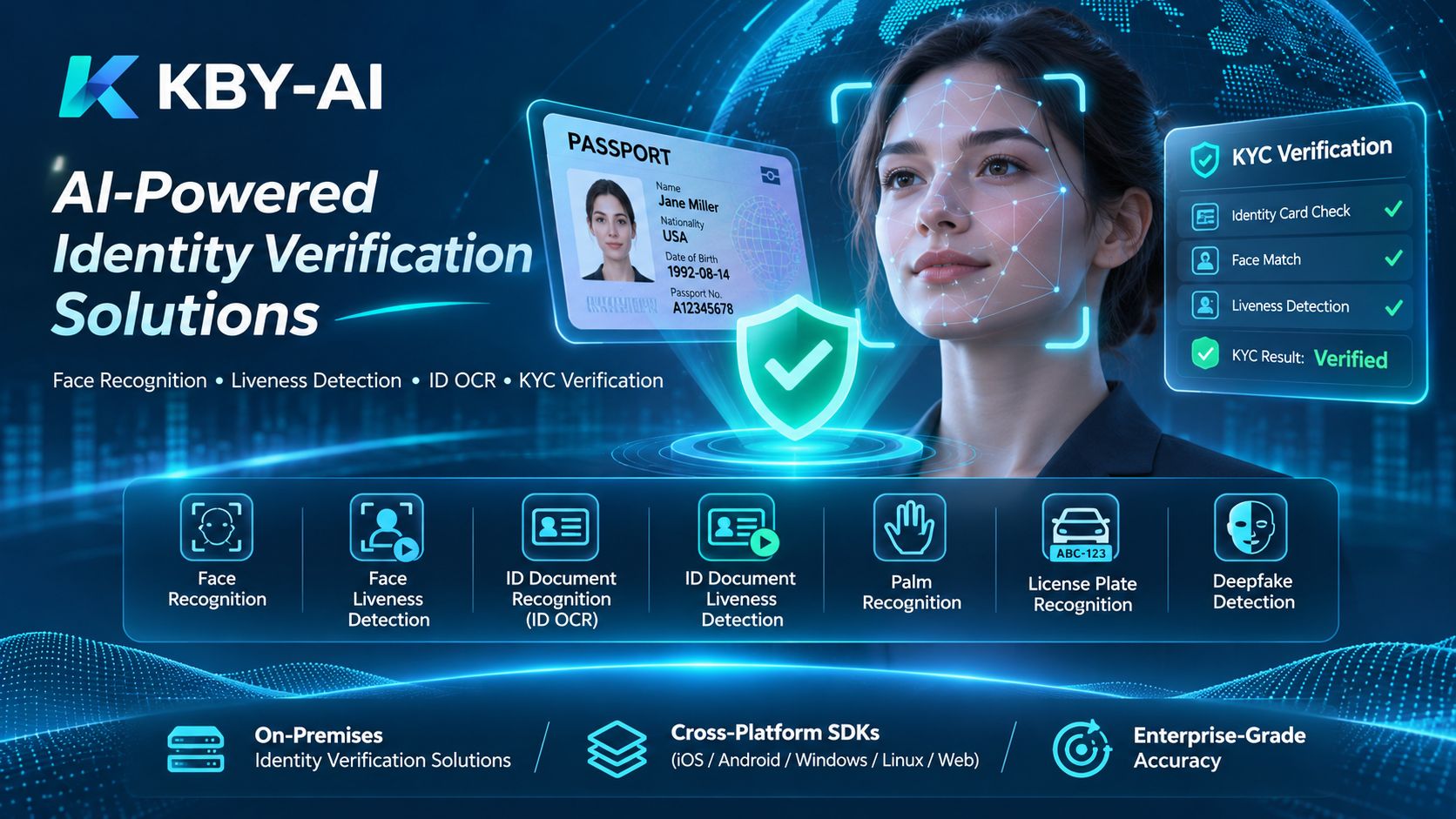
Discover how KBY-AI helps businesses build secure, scalable identity verification systems with advanced biometric technology, cross-platform SDKs, and on-premises deployment.
As digital services continue to grow, businesses face an increasingly important challenge: how can they verify identities accurately, securely, and efficiently without creating unnecessary friction for their users?
From financial technology and digital banking to online marketplaces, healthcare applications, and enterprise security systems, reliable identity verification has become an essential part of building trust in the digital world.
Traditional identity verification processes can be slow, expensive, and vulnerable to sophisticated fraud attempts. As businesses expand globally, they need smarter technologies capable of delivering accurate results while supporting different platforms, deployment environments, and security requirements.
This is where KBY-AI comes in.
KBY-AI develops artificial intelligence-powered identity verification solutions, offering advanced biometric recognition, document processing, liveness detection, and Know Your Customer (KYC) technologies designed for modern applications.
With its comprehensive SDK portfolio, flexible integration options, and support for on-premises deployment, KBY-AI helps organizations bring advanced identity verification capabilities into their own products.
What Is KBY-AI?
KBY-AI is an AI technology provider specializing in computer vision, biometric recognition, and digital identity verification.
The company offers a collection of software development kits (SDKs) and solutions that allow developers and organizations to integrate identity-related capabilities directly into existing websites, mobile applications, enterprise platforms, and backend systems.
Rather than requiring businesses to build complex biometric algorithms from scratch, KBY-AI provides ready-to-integrate technologies for identity recognition, fraud prevention, and automated verification.
Its solutions include:
-
Face Recognition SDK: AI-powered facial identification and verification.
-
Face Liveness Detection SDK: Technology designed to detect presentation attacks and distinguish live users from spoofing attempts.
-
ID Document Recognition SDK: Automated extraction and recognition of identity document information.
-
ID Document Liveness Detection SDK: Detection of common document presentation and manipulation attacks.
-
Palm Recognition SDK: Biometric recognition using palmprints and palm veins.
-
License Plate Recognition SDK: Automated vehicle license plate recognition.
-
KYC Verification Solution: Integrated identity verification workflows combining document analysis, facial matching, and liveness detection.
-
Deepfake Detection API: Technology designed to help identify AI-manipulated visual content.
Together, these solutions provide a flexible foundation for organizations building secure digital onboarding, authentication, and identity management experiences.

1. Face Recognition: Intelligent and Accurate Identity Verification
Facial recognition technology has become an important component of modern digital authentication.
KBY-AI’s Face Recognition SDK uses computer vision and biometric matching algorithms to compare facial images and support identity verification workflows.
The technology can be integrated into applications that require facial identification, user authentication, or biometric matching.
Potential applications include:
-
Digital customer onboarding
-
Employee identity verification
-
Access control systems
-
Financial application authentication
-
Customer account security
-
Identity matching for online services
KBY-AI also highlights its performance in the National Institute of Standards and Technology (NIST) Face Recognition Vendor Test evaluations, providing a useful external reference point for organizations assessing facial recognition technology.
For companies looking to introduce biometric authentication, the SDK offers an alternative to developing and maintaining their own facial recognition models.
2. Face Liveness Detection: Protecting Against Identity Spoofing
Facial recognition alone cannot address every identity-related security threat.
Attackers may attempt to deceive verification systems using printed photographs, digital screens, prerecorded videos, or other presentation techniques.
Face liveness detection adds an important layer of protection.
KBY-AI offers both passive and active liveness detection technologies.
Passive liveness detection analyzes facial information without necessarily requiring the user to perform additional movements.
Active liveness detection can incorporate interactive verification steps intended to establish that a genuine person is present.
These technologies can help organizations reduce exposure to common face spoofing techniques while improving the security of remote identity verification.
Combining facial recognition with liveness detection is particularly valuable for applications involving remote registration, account access, and high-risk transactions.
3. ID Document Recognition: Automating Identity Data Extraction
Manual identity document processing creates operational overhead and can introduce data-entry errors.
KBY-AI’s ID Document Recognition SDK uses optical character recognition (OCR) and computer vision to recognize identity documents and extract relevant information.
According to the company, its document recognition technology supports identity documents from more than 200 countries.
Supported document categories include passports, national identity cards, and driver’s licenses.
This functionality can help businesses automate information capture during onboarding and reduce the amount of manual data entry required.
Common use cases include:
-
Financial services onboarding
-
Customer identity verification
-
Travel-related identity processing
-
Insurance application processing
-
Digital account registration
-
Enterprise document verification
For organizations working with international customers, broad document coverage can be especially valuable.
4. ID Document Liveness Detection: Adding Protection Against Document Fraud
Document recognition extracts information, but it does not necessarily establish whether the presented document is genuine or physically present.
That distinction is important because identity verification systems may encounter printed reproductions, screen-displayed documents, or altered photographs.
KBY-AI’s ID Document Liveness Detection SDK is designed to identify common presentation attacks, including screen replay, printed-copy, and portrait-substitution attacks.
When combined with document OCR and facial recognition, document liveness detection can support a more comprehensive identity verification process.
This layered approach is particularly relevant for organizations that must evaluate both the document presented and the person submitting it.
5. KYC Verification: A More Complete Digital Onboarding Workflow
Know Your Customer (KYC) verification is an important requirement for many organizations operating in regulated industries.
An effective identity verification workflow may involve validating document information, comparing a person’s face with their identification document, and evaluating whether the biometric capture is authentic.
KBY-AI combines several technologies to support these workflows:
Step 1: Document capture
The user submits an image of an accepted identity document.
Step 2: Document recognition
The system extracts relevant information using ID document recognition technology.
Step 3: Facial matching
Facial recognition compares the user’s captured face with the reference image from the identity document.
Step 4: Liveness assessment
Face liveness detection evaluates whether the captured facial presentation appears to come from a live person.
Step 5: Application decision
The business processes the verification results according to its own risk policies, compliance requirements, and approval workflow.
By integrating these capabilities, organizations can reduce manual processing and build more consistent digital onboarding experiences.
It is important to recognize that identity verification technology supports KYC programs but does not independently guarantee regulatory compliance. Organizations still need appropriate risk assessments, sanctions screening, data protection measures, and other applicable controls.
6. Palm Recognition and License Plate Recognition
Beyond conventional identity document and facial verification, KBY-AI offers specialized computer vision technologies.
Palm Recognition
The Palm Recognition SDK supports biometric capabilities involving palmprints and palm veins.
Potential applications include physical access control, attendance systems, and specialized biometric identity management.
Palm-based verification can provide an additional authentication option in environments where organizations want alternatives to facial recognition.
License Plate Recognition
KBY-AI’s License Plate Recognition SDK is designed to automatically detect and recognize vehicle registration plates.
Potential applications include:
-
Parking access management
-
Vehicle entry and exit systems
-
Transportation operations
-
Logistics facilities
-
Automated vehicle identification
These technologies expand the range of business applications that can benefit from KBY-AI’s computer vision capabilities.
7. Flexible Integration and On-Premises Deployment
One of KBY-AI’s notable advantages is its focus on flexible SDK deployment and integration.
The company supports development environments and technologies including Python, Java, Kotlin, Swift, C++, C#, JavaScript, Flutter, React Native, and Ionic Cordova.
This flexibility helps engineering teams integrate identity verification technologies into existing software ecosystems.
KBY-AI also offers on-premises and offline-capable solutions, allowing supported workloads to operate within an organization’s own infrastructure or devices.
For businesses with specific data residency, privacy, network connectivity, or infrastructure requirements, these deployment options can be particularly useful.
Local processing can also reduce dependence on external verification services for supported functions.
Organizations should evaluate deployment requirements, hardware compatibility, licensing terms, and applicable privacy obligations before implementation.
8. Why Businesses Should Consider KBY-AI
Selecting an identity verification provider involves more than evaluating recognition accuracy.
Organizations also need to consider implementation complexity, deployment flexibility, security requirements, maintenance, and long-term operating costs.
KBY-AI offers several characteristics worth evaluating.
Comprehensive SDK portfolio
Multiple biometric and document recognition capabilities are available from one technology provider.
Cross-platform development support
Developers can integrate SDKs into a broad range of application environments.
On-premises deployment options
Supported products can be deployed within an organization’s own infrastructure, providing greater control over processing environments.
Perpetual licensing options
KBY-AI advertises perpetual SDK licensing and one-time payment options, which may appeal to organizations seeking alternatives to recurring usage-based pricing.
Technical support and documentation
The company provides technical documentation and integration support to assist development teams.
These capabilities make KBY-AI a potential choice for businesses evaluating a new identity verification solution or upgrading an existing system.
9. Real-World Applications Across Industries
AI-powered identity verification can provide value across a wide range of industries.
Financial technology and digital banking
Support customer onboarding, facial matching, and identity document processing.
Healthcare and digital services
Assist with identity verification for access to sensitive digital services, subject to appropriate privacy and security controls.
E-commerce and online marketplaces
Strengthen identity verification during seller registration and other higher-risk account activities.
Travel and hospitality
Automate identity document recognition and streamline selected guest registration workflows.
Enterprise security
Integrate biometric identification into access management and operational security systems.
Transportation and parking
Use license plate recognition for vehicle access and operational automation.
The appropriate combination of SDKs will depend on each organization’s security needs, regulatory requirements, user experience goals, and infrastructure.
10. Getting Started with KBY-AI
Organizations interested in exploring KBY-AI can begin by evaluating the available SDK demonstrations and technical resources.
The company provides online evaluation options, product documentation, and access to its development resources.
A practical evaluation process includes identifying the intended use case, selecting the relevant SDK, testing recognition performance with representative data, reviewing deployment requirements, and assessing integration effort.
Developers should also evaluate security, accuracy, performance under real operating conditions, and the handling of biometric and personal information.
Explore the available resources:
-
Official website: https://kby-ai.com/
-
Product documentation: https://docs.kby-ai.com/
-
Online demonstration: https://web.kby-ai.com/
Final Thoughts: Building Safer Digital Experiences with AI
As more services move online, reliable identity verification will remain an important part of digital security and customer trust.
Businesses need solutions that balance recognition performance, fraud prevention, user experience, privacy, and operational flexibility.
KBY-AI brings together facial recognition, liveness detection, document recognition, KYC verification, and other computer vision capabilities through a comprehensive portfolio of SDKs.
Its cross-platform development support and on-premises deployment options make it worth considering for organizations building or modernizing digital identity systems.
Whether you’re a software developer evaluating biometric SDKs, a technology leader planning a new identity verification workflow, or a business exploring fraud prevention technologies, KBY-AI offers practical tools to investigate.
Ready to explore AI-powered identity verification?
Visit KBY-AI to discover its SDKs, explore online demonstrations, and evaluate the right solution for your application.
Build smarter verification experiences. Strengthen digital trust. Explore KBY-AI.